Diagnose
Compare 435 block pairs with equal parameter budgets using video and action gradients.
WORLD ACTION MODELS
Jointly learning visual dynamics and robot actions through sparse, conditional gradient routing.
Anonymous authors · Research manuscript
98.8%
Average success +1.2 pp93.0%
Average success +1.2 pp2 / 30
Selected on LIBERO37.8M
10 video K/V tensorsTables 1 and 2 · Gains over Fast-WAM in percentage points · RoboTwin average over clean and randomized settings
01 / MOTIVATION
Joint video and action learningVideo and action gradients can agree across the model while conflicting within individual blocks. ConGR-WAM identifies a sparse subspace and adjusts its gradients only when conflict occurs.
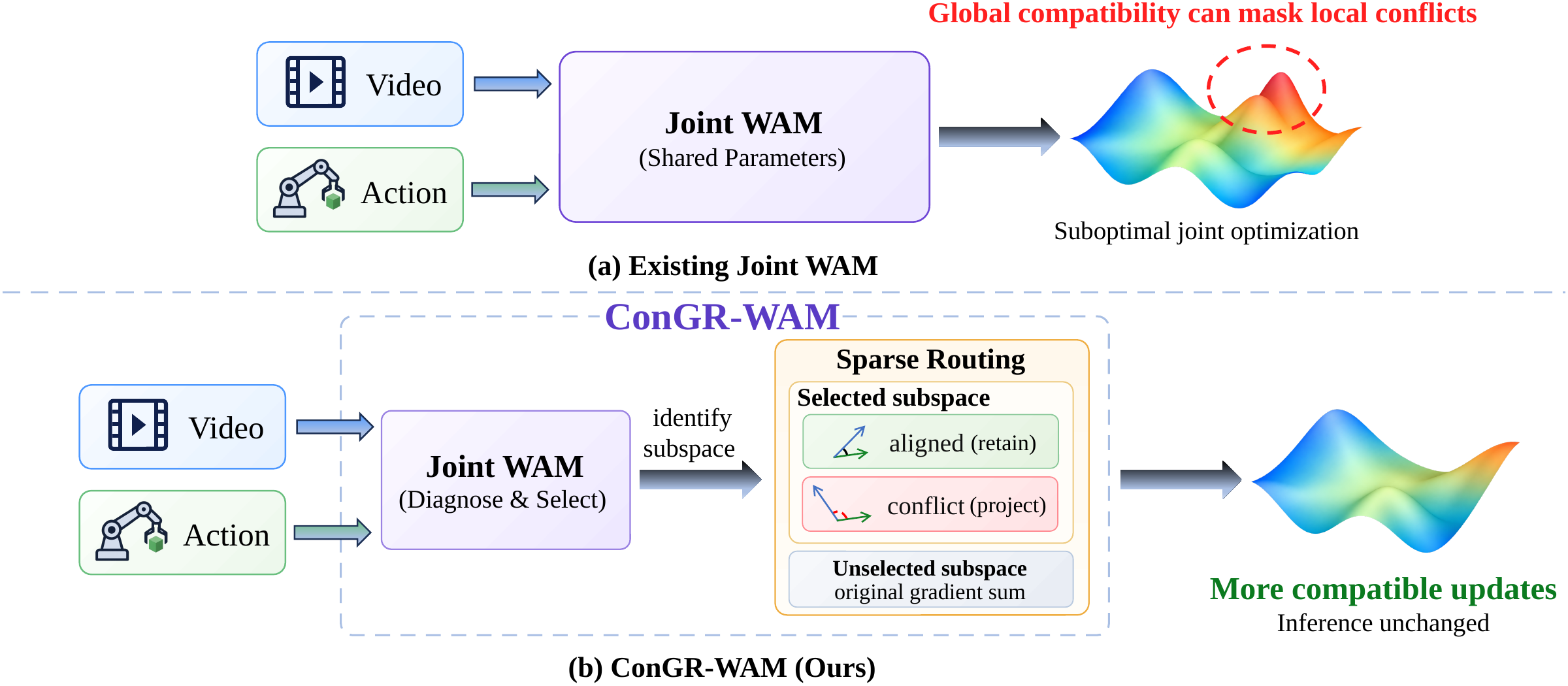
Joint World Action Models learn visual dynamics and robot control together, yet global gradient alignment can conceal local conflicts between the two objectives. An analysis of video K/V parameters reveals a stable spatial pattern of conflict across training checkpoints and task suites, while conflict within a given subspace varies across optimizer steps. ConGR-WAM uses this structure to guide sparse gradient routing, separating where to intervene from when to intervene. Offline diagnosis constructs a conflict topology over block-pair subspaces with equal parameter budgets, yielding a sparse intervention subspace selected from gradient evidence through a tail-robust maximin criterion. During training, symmetric projection is applied only when the video and action gradients conflict within the selected subspace. Routing preserves the original gradient sum elsewhere and on nonconflicting steps. Controlled ablations show that routing in the diagnosed subspace outperforms random sparse and dense conditional alternatives, and that conditional activation improves over unconditional projection. On LIBERO and RoboTwin 2.0, ConGR-WAM achieves state-of-the-art performance among comparable World Action Models, while leaving the model architecture, parameter count, and inference procedure unchanged. Our project materials are available at the anonymous repository.
02 / METHOD
Offline diagnosis · Conditional trainingThe routing subspace is selected before training. At each optimizer step, symmetric projection activates only if the video and action gradients conflict within that subspace.
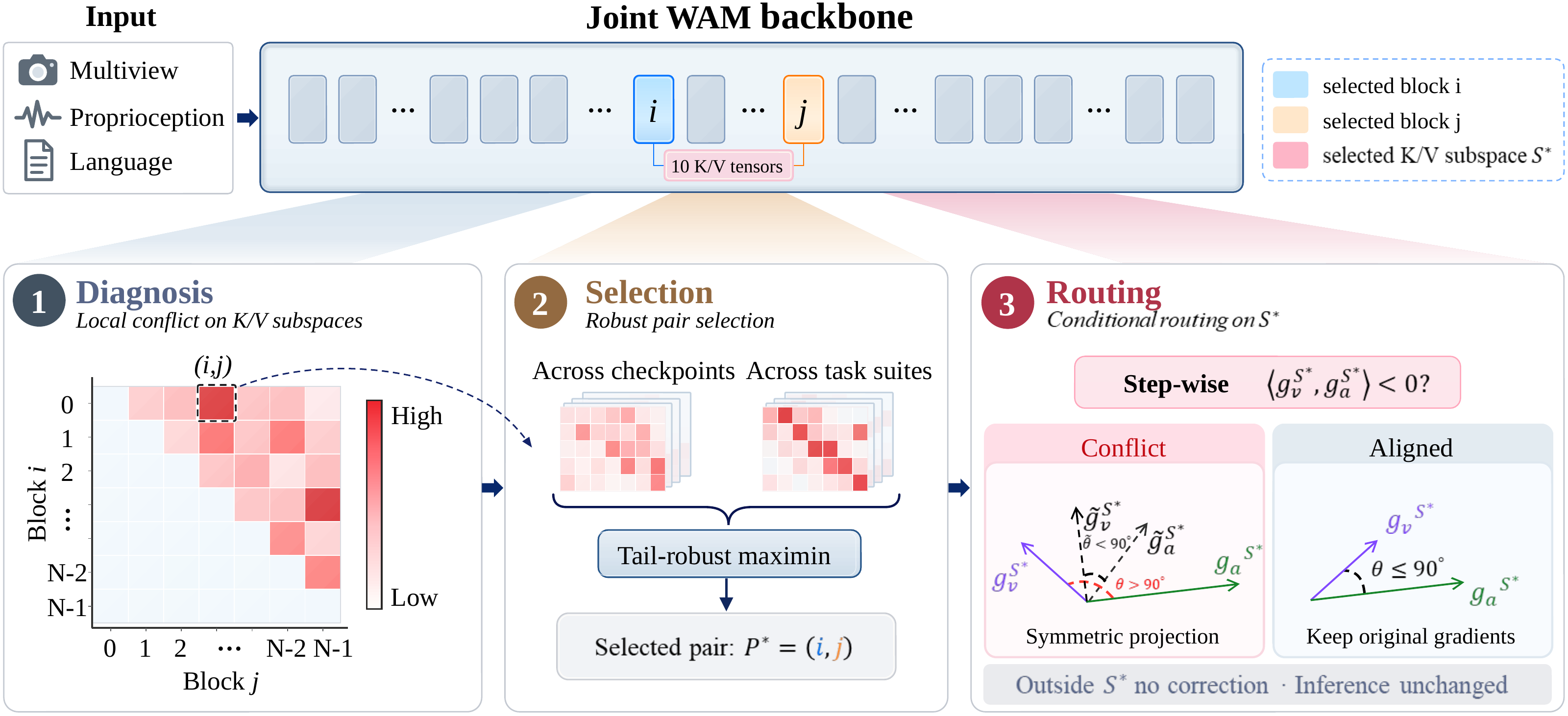
Compare 435 block pairs with equal parameter budgets using video and action gradients.
Use a tail-robust maximin criterion across checkpoints and task suites to select one sparse subspace.
Project conflicting gradients in the selected subspace. Preserve the original sum elsewhere and on aligned steps.
LIBERO selects video blocks 0 and 8. The subspace is selected independently for each benchmark.
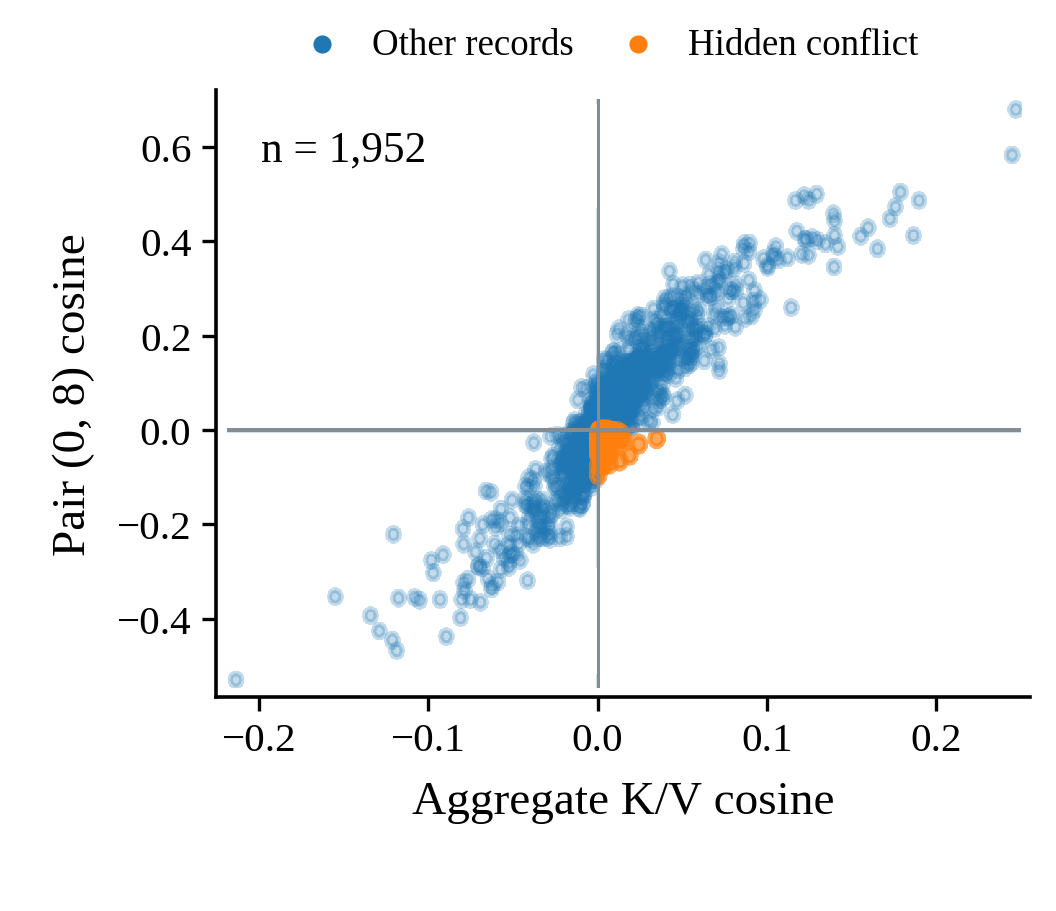
of globally aligned records contain local conflict
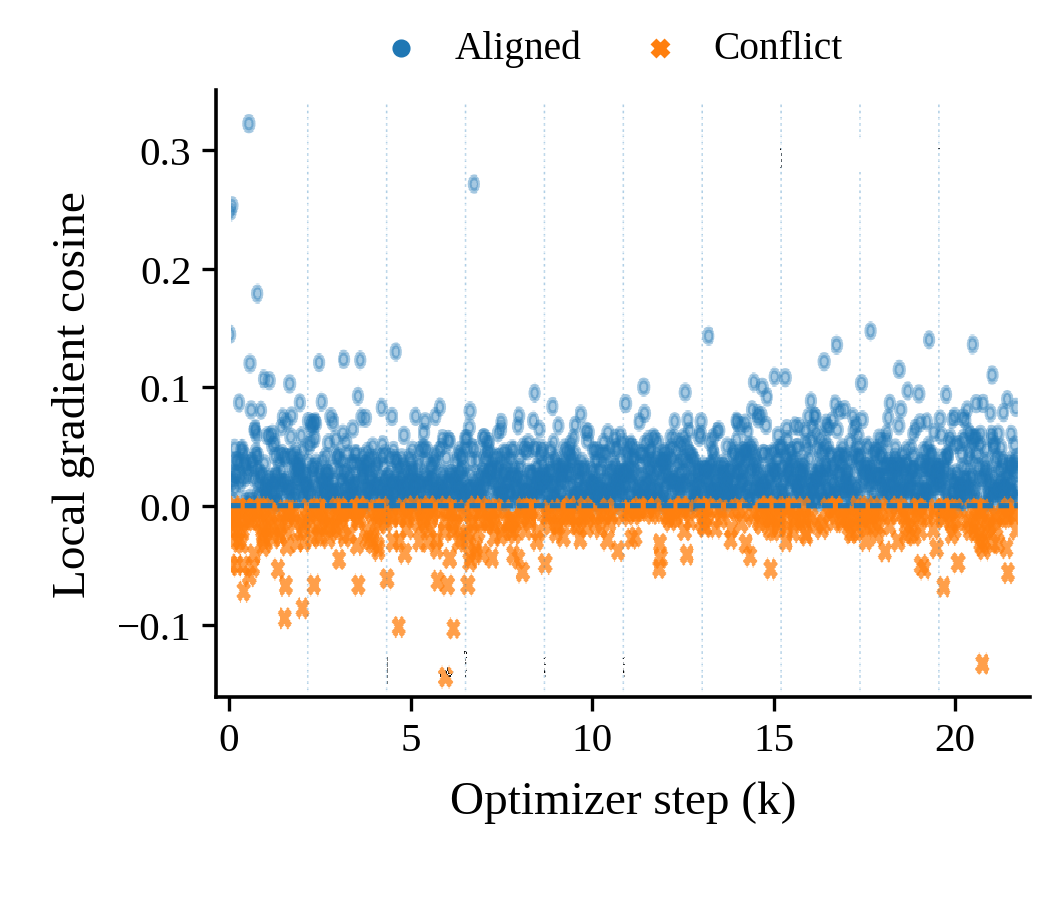
of sampled training steps activate routing
03 / IN MOTION
Recorded simulation rolloutsSingle-arm and bimanual manipulation on LIBERO and RoboTwin 2.0
Transfers the microphone between grippers.
Does not complete the handover.
The main camera view is cropped from the original recording. The all-camera view shows the complete recording. Both views retain the full episode at its recorded speed. Each video ends at its own terminal frame.
All four comparisons show a successful ConGR-WAM episode on the left and a failed Fast-WAM episode on the right. The RoboTwin 2.0 recordings use similar scenes within the same setting. The LIBERO recordings use the same task and trial. Each panel is a separate recording. These selected examples do not estimate benchmark success rates. Playback duration does not measure inference latency.
04 / RESULTS
Quantitative evaluationArchitecture, parameter count and inference procedure remain unchanged.
40 tasks4 suites · 50 trials per task · 2,000 outcomes
98.8% average success
| Method | Robot PT | Spatial | Object | Goal | Long | Average |
|---|---|---|---|---|---|---|
| OpenVLA | Yes | 84.7 | 88.4 | 79.2 | 53.7 | 76.5 |
| π0 | Yes | 96.8 | 98.8 | 95.8 | 85.2 | 94.1 |
| π0.5 | Yes | 98.8 | 98.2 | 98.0 | 92.4 | 96.9 |
| LingBot-VA | Yes | 98.5 | 99.6 | 97.2 | 98.5 | 98.5 |
| Motus | Yes | 96.8 | 99.8 | 96.6 | 97.6 | 97.7 |
| VITA | Yes | 95.9 | 98.9 | 95.1 | 96.8 | 96.7 |
| PFD | No | 98.6 | 99.2 | 99.2 | 95.4 | 98.1 |
| Fast-WAM baseline | No | 98.2 | 100.0 | 97.0 | 95.2 | 97.6 |
| ConGR-WAM ours | No | 100.0 | 99.4 | 100.0 | 95.8 | 98.8 |
50 bimanual tasks2 settings · 100 episodes per task and setting · 10,000 episodes
93.0% average success
| Method | Robot PT | Clean | Randomized | Average |
|---|---|---|---|---|
| π0 | Yes | 65.9 | 58.4 | 62.2 |
| π0.5 | Yes | 82.7 | 76.8 | 79.8 |
| Motus | Yes | 88.7 | 87.0 | 87.8 |
| Motus from WAN2.2 | No | 77.6 | 77.0 | 77.3 |
| LingBot-VA | Yes | 92.9 | 91.5 | 92.2 |
| X-WAM | Yes | 89.8 | 90.7 | 90.3 |
| AttenA+WAM | No | 93.1 | 91.9 | 92.5 |
| Fast-WAM baseline | No | 91.9 | 91.8 | 91.8 |
| ConGR-WAM ours | No | 93.2 | 92.7 | 93.0 |
Both clean and randomized settings use unseen language instructions. Average is calculated from unrounded clean and randomized rates, then reported to one decimal place.
Robot PT denotes robot pretraining before benchmark adaptation. Bold marks the best value in each metric column. Method references and full protocols are in the paper.
CONTROLLED ABLATIONS
Diagnosed sparse routing reaches 98.8% on LIBERO. Random sparse pairs, dense conditional routing, and unconditional projection all yield lower success under the reported controls.
The selected subspace contains 37.8 million parameters across video blocks 0 and 8.
| Routing variant | Parameters routed | Success |
|---|---|---|
| Random sparse R1 blocks 7 and 8 | 37.8M | 96.7% |
| Random sparse R2 blocks 9 and 19 | 37.8M | 97.4% |
| Dense conditional | 566.5M | 97.6% |
| Unconditional projection blocks 0 and 8 | 37.8M | 96.9% |
| ConGR-WAM blocks 0 and 8 · on conflict | 37.8M | 98.8% |
One-time diagnosis on four GPUs, including model loading and gradient collection on existing checkpoints; checkpoint training is excluded.
Training step overhead 8.3 s vs. 7.3 s under matched timing conditions.
Policy-core parameters in both methods, excluding the frozen VAE.
Table 5 · Inference operators are identical. Measured inference batch runtime is 865.6 ms for ConGR-WAM and 863.3 ms for the baseline. Both measurements are inference batch runtimes.
PROJECT RESOURCES
Project page assets, figures and recorded demonstrations.